

Diane Victor is one of five outstanding female artists to be profiled in the #5WomenArtist Campaign. The campaign is powered by the National Museum of Women in the Arts, New York. Oliewenhuis Art Museum is participating in the global campaign and has identified five artworks by female artists from the Permanent Collection to participate in this campaign.
The five female artists are Nandipha Mntambo, Nomusa Makhubu, Helen Sebidi, Penny Siopis and Diane Victor. They were selected for their extraordinary career achievements. In addition, they speak up and address contemporary debates, relating not only to South Africa, but also current issues globally.
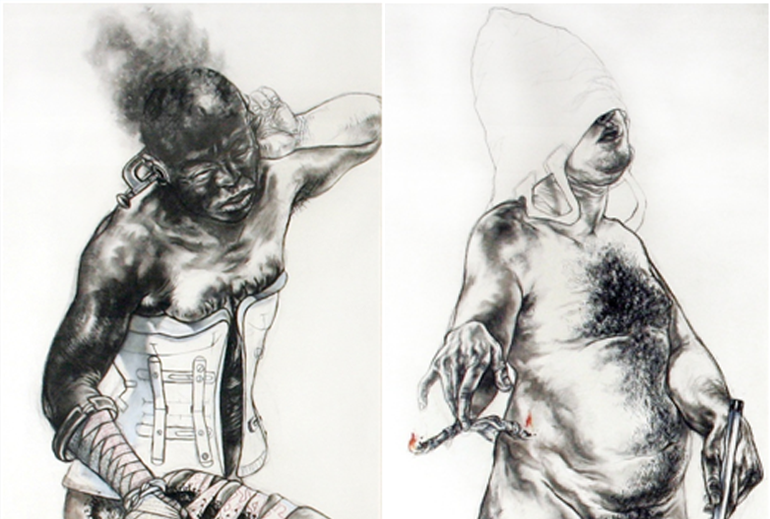
Truth dance Charcoal and pastel on paper 1998-1999
Johannesburg based artist, Diane Victor, is probably one of South Africa’s most renowned artists for portraying the strikingly ugly truths about South African topics. Victor is a full time artist, specialising in printmaking and drawing and has been part time lecturing at different tertiary institutions in South Africa. In 1986 Victor obtained a BA degree in Fine Arts at the University of the Witwatersrand. Her career as an artist is noteworthy for winning several reputable awards; to name a few, the Sasol New Signatures (1986), Absa l’Atelier (1988) and International Printmaking Award for Foreign entry – Guanlan Printmaking Biennal, China (2013). She participated in many solo and group exhibitions, locally and abroad, and her work is represented in many prestigious collections such as Iziko, South African National Gallery, Oliewenhuis Art Museum, Standard Bank Collection, Museum of Modern Art, New York and the National Library of France.
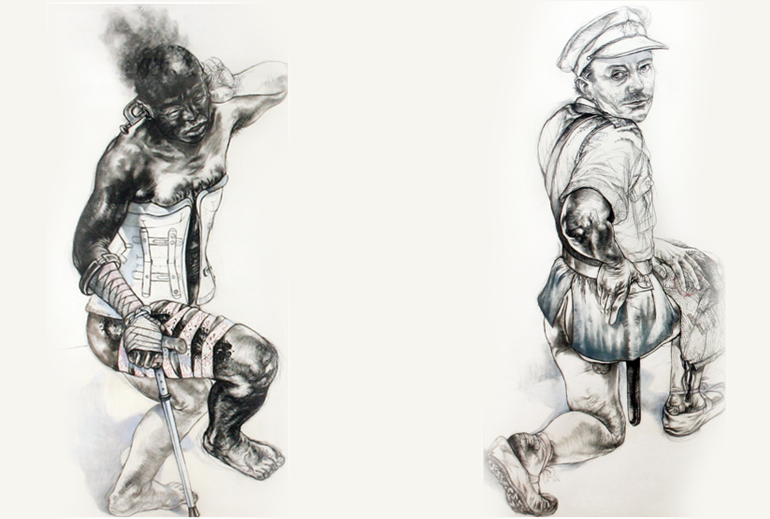
Truth dance Charcoal and pastel on paper 1998-1999
Victor is an artist that is celebrated for her extraordinary drawing talent. She expresses herself either with charcoal on paper, drawing with the smoke of a burning candle on paper and glass, or meticulous printmaking techniques such as etching, embossing or lithography. She often uses parody and dark humour to voice her frustrations in her surroundings and questions unsettling topics such as gender inequality, government corruption, violence against women and children, rape, and notions about religion or religious iconography.
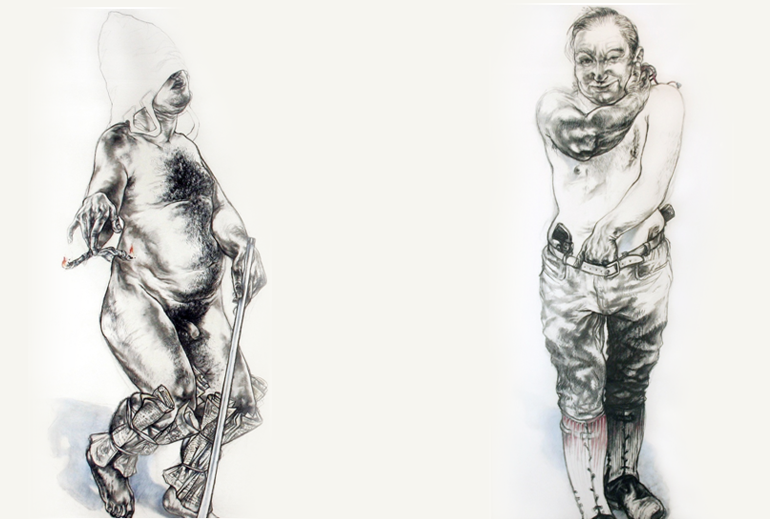
 Truth dance Charcoal and Pastel on paper 1998-1999
Photographs are available at the Oliewenhuis Art museum archive
With The Truth Dance series (1998-1999), Victor questions views about the ‘truth’ through a performative play of different male characters. Some of these characters are dressed in uniform but Victor chooses to distort the conventional uniforms or attires with unconventional items such as corsets, suggestive phallic symbols, bandages and uncomfortable poses that make these men look vile, arrogant or even like paedophiles.
Some of the characters are to a certain extent recognizable, ‘reputable’ authority figures in society, for example a policeman and politician. The series of men is portrayed to make the viewer doubtful of their sincerity as their faces become like masks and their bodies become symbols of the misuse of patriarchal power in society. The reference to the justice figure summarises this series as ‘justice’ is now portrayed as a blinded man (not blindfolded women as traditionally depicted) and the supposed scale in his hand is burning on both ends. Victor is, therefore, either seeking truth or questioning the proposed truths by interrogating authority and justice in the world.
The Truth Dance series (1998-1999) was purchased from the artist following a combined exhibition with Ian Marley that was held at Oliewenhuis Art Museum in 2001. Oliewenhuis Art Museum is a satellite of the National Museum in Bloemfontein, an agency of the Department of Arts and Culture, South Africa.
Bibliography
Croucamp, A. 2009. Mmakgabo Mmapula Mmankgato Helen Sebidi: Educational Supplement Taxi Art Books Series, Taxi 041. Johannesburg: David Krut publishing.
Louw, E, Beukes, M & Van Wyk, L. 2013. Visual Arts Learners Guide. Mowbray: Future Managers.
Makhubu, N. Intertwined: A selection of photographs by Nomusa Makhubu 20015-2017. Cape Town: Erdmann Contemporaries.
Simbao, R & Elliott, D. 2011. Nandipha Mntambo, Johannesburg: Stevenson.
Smith, K. 2004. Penny Siopis. In Perryer, S, Bedrord, D, Broodie, T & Goiwe, T. 2004. 10 Years, 100 artists. Art in a democratic South Africa. Cape Town: Bell-Roberts.



Comments are closed.