

Nandipha Mntambo is one of five outstanding female artists profiled in the #5WomenArtist Campaign. The campaign is powered by the National Museum of Women in the Arts, New York. Oliewenhuis Art Museum is participating in the global campaign and has identified five artworks by female artists from the Permanent Collection to participate in this campaign.
The five female artists are Nandipha Mntambo, Nomusa Makhubu, Mmakgabo Mmapula Helen Sebidi, Penny Siopis and Diane Victor. They were selected for their extraordinary career achievements. In addition, they speak up and address contemporary debates, relating not only to South Africa, but also current issues globally.
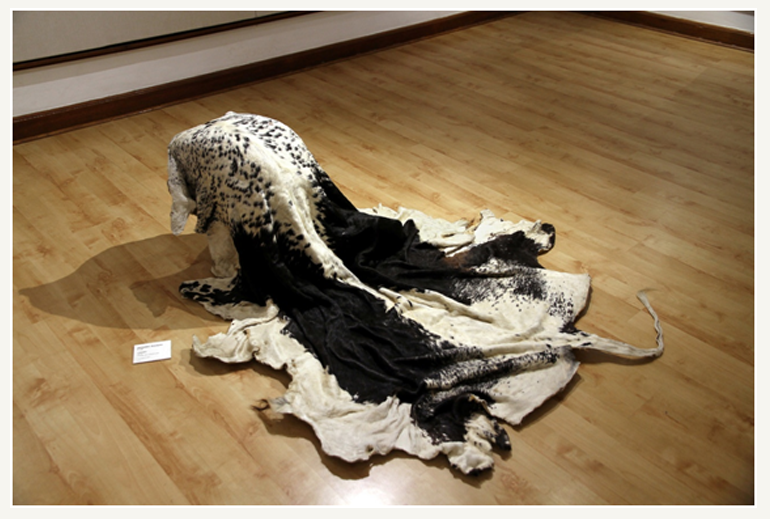 Chimera 2012 Cowhide, resin and polyester mesh Photo credit: Kobus Robertse
Photograph available at the Oliewenhuis Art Museum archive
Johannesburg-based artist, Nandipha Mntambo, was born in Swaziland in 1982. During 2007 she obtained a Master’s Degree in Fine Arts at the Michaelis School of Fine Art at the University of Cape Town. In 2012 Mntambo won the high-status Standard Bank Young Artist Award. Mntambo has an outstanding exhibition history as she participated in numerous group and solo exhibitions in South Africa, Brooklyn Museum in New York, Venice Biennale and in Washington, New York.
Chimera (2012) is an artwork that formed part of her solo exhibition, The Unspoken, at Stevenson Gallery in Cape Town during 2012. Choosing cowhide as preferred medium (her process involves a series of chemical processes to manipulate the raw cow hide and stretch it onto plaster casts of her own body), make these art works both fascinating and repellent. The cowhide sculpture replaces human skin; the textures capture the female form both in a kneeling position and in the resemblance of a dress. The kneeling position of the figure can lead to notions about the female body, perhaps in a submissive or in a praying pose. Artist and curator, Gabi Ngcobo explained that Mntambo’s work encourages us to critique the politics and aesthetics of femininity and beauty and is suggestive of the ways in which (black) women are re-interpreting their bodies and claiming visibility (Louw, E, Beukes, M & Van Wyk, L 2013: 299)
The hairy skin in female form is used, Mntambo says, to ‘challenge and subvert preconceptions regarding representation of the female body’ and to ‘disrupt perceptions of attraction and repulsion’. The artist is also interested in how the human figure merges into animal and that we tend to forget that “we are all animals as well”. Choosing to work with cowhide, her work is automatically linked with African rituals and traditions. However Mntambo states that “cowhide is the material I have chosen as a means of expression. It is a product of my artistic thinking. I wanted to be a forensic pathologist and I really love chemicals and understanding the chemical process…I don’t know if that is the only reason, but my beginning of using cowhide was a very private, strangely spiritual experience of having a dream I cannot really remember. But I do remember there were cows in the dream. This is why I chose the material. I enjoy exploring how a chemical process can give me a certain amount of control over this organic material” (Simbao 2011: 15).
Chimera was purchased by Oliewenhuis Art Museum in 2012 from Michael Stevenson Fine Art CC and is on show in our Permanent Collection exhibition area. Oliewenhuis Art Museum is a satellite of the National Museum in Bloemfontein, an agency of the Department of Arts and Culture, South Africa.
Bibliography
Croucamp, A. 2009. Mmakgabo Mmapula Mmankgato Helen Sebidi: Educational Supplement Taxi Art Books Series, Taxi 041. Johannesburg: David Krut publishing.
Louw, E, Beukes, M & Van Wyk, L. 2013. Visual Arts Learners Guide. Mowbray: Future Managers.
Makhubu, N. Intertwined: A selection of photographs by Nomusa Makhubu 20015-2017. Cape Town: Erdmann Contemporaries.
Simbao, R & Elliott, D. 2011. Nandipha Mntambo, Johannesburg: Stevenson.
Smith, K. 2004. Penny Siopis. In Perryer, S, Bedrord, D, Broodie, T & Goiwe, T. 2004. 10 Years, 100 artists. Art in a democratic South Africa. Cape Town: Bell-Roberts.



Comments are closed.