


Largest lizard described from Southern Africa in 82 years
Dr Michael Bates of the Herpetology Department and co-author Dr Edward Stanley of the Florida Museum of Natural History (Gainesville, USA) have just published a taxonomic revision of the rock-dwelling, south-eastern dragon lizards of South Africa, Eswatini and Mozambique. The article was published in the high-impact international journal PeerJ, and includes the description of a new species, the Swazi Dragon Lizard (Smaug swazicus), found in Eswatini (previously ‘Swaziland’) and adjacent parts of KwaZulu-Natal and Mpumalanga provinces. This article was published in ‘open view’ and is therefore available for free viewing or downloading at https://doi.org/10.7717/peerj.8526.
 This study is a follow-up to a genetics study published by Stanley & Bates (2014) in the Zoological Journal of the Linnean Society, in which an analysis of genetic markers (mitochondrial and nuclear DNA) showed that what was thought to be a single species, the Barberton Dragon Lizard (Smaug barbertonensis), was in fact two different species. The genetic analysis had shown that samples from the type locality (Barberton) of S. barbertonensis represented a different evolutionary lineage to samples from Eswatini, which were more closely related to the Lebombo Dragon Lizard (Smaug warreni), a species restricted to the narrow Lebombo Mountain range on the eastern border of Eswatini. In fact, a time-calibrated phylogenetic analysis conducted as part of the Stanley & Bates (2014) study indicated that the Barberton Dragon Lizard and the other two species (at that time a single species) had diverged during the Miocene epoch, about 7.5 million years ago. The other two species, S. warreni and S. swazicus, diverged around 6.2 million years ago.
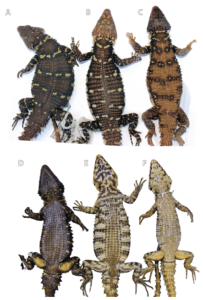
After examining all relevant specimens used in the genetic analysis, as well as other museum specimens, Mike realised that the three species could be separated by their distinct colour patterns (see photos). For example, the belly markings of each species are very different, and S. barbertonensis has a pale spot or blotch behind the head instead of a band, which is present in the other two species. He also determined that there were differences in scale counts and relative head size, and high-resolution computed tomography (CT scanning) conducted by co-author Dr Stanley also indicated differences in the morphology of the quadrate bone in the skull, and the distribution of osteoderms (bony plates) in the skin. In terms of body girth and total length (body plus tail), this new species, Smaug swazicus, is the largest species of lizard to be described from southern Africa in 82 years.
Colour patterns of the three south-eastern species of dragon lizards: A & D: Barberton Dragon Lizard (Smaug barbertonensis), B & E: Swazi Dragon Lizard (Smaug swazicus) and C & F: Lebombo Dragon Lizard (Smaug warreni). (Photos: Michael Bates)
The Swazi Dragon Lizard (Smaug swazicus), largest species of lizard described from southern Africa in 82 years. (Photo: Edward Stanley)
References
Stanley, E.L. & M.F. Bates. 2014. Here be dragons: a phylogenetic and biogeographical study of the Smaug warreni species complex (Squamata: Cordylidae) in southern Africa. Zoological Journal of the Linnean Society 172: 892‒909.
Bates, M.F. & E.L. Stanley. 2020. A taxonomic revision of the south-eastern dragon lizards of the Smaug warreni (Boulenger) species complex in southern Africa, with the description of a new species (Squamata: Cordylidae). PeerJ 8:e8526 https://doi.org/10.7717/peerj.8526 (PP. 1-41).
Text by Michael F. Bates


Comments are closed.