

Oliewenhuis Art Museum and Art Bank South Africa joined forces in participating in the powerful #5WomenArtists campaign powered by the National Museum of Women in the Arts, New York. Both Oliewenhuis Art Museum and Art Bank South Africa are agencies of the Department of Sport, Arts and Culture and Departments of the National Museum in Bloemfontein, South Africa. We proudly present outstanding female artists’ work from our collections to participate in this extraordinary campaign.
The selected five female artists are a combination of well established female icons in the art industry juxtaposed by upcoming, promising contemporary talent sourced from the collections of Oliewenhuis Art Museum and Art Bank South Africa.
The selected iconic established female artists are Helen Sebidi, Noria Mabasa and the fearless contemporary promising female artists are Thandiwe Msebenzi, Nomusa Mtshali, and Kimathi Mafafo. These female artists were not only selected for their extraordinary career achievements but also because they speak up and address contemporary debates, relating not only to South Africa but also current issues globally. This includes queer and gender theories, gender as a performative act, sexual harassment, rape culture, and some are actively part of the #metoo movement. The selection of the female artists’ work is interesting as their visual dialogues vary from delicate embroideries, photographs, mixed media on paper, wood-carved sculptures, and etchings.
Noria Mabasa: #5WomenArtists Campaign
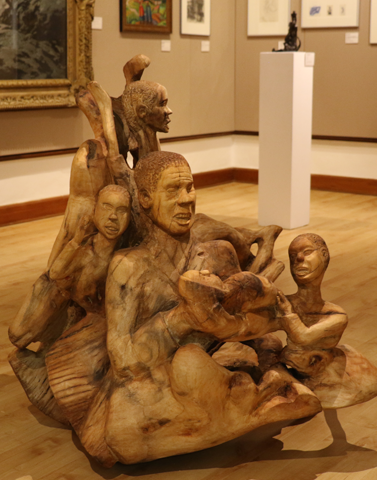
Oliewenhuis Art Museum’s most recent acquisition, Born from Fire, is an exceptional sculptural masterpiece by Mam Noria Mabasa.
Noria Mabasa was born in 1938 in Tsigalo, Venda. Today she lives and works in Vuwani, Venda. She had no formal institutional art training but received local training in the making of clay pots and has been a full-time artist since 1976. Like many other rural artists, she explains that the source of her creativity lies in dreams and instructions from an ancestor. She is the only Venda woman who sculpts in wood and her works deal mostly with traditional issues, particularly those pertaining to women, as well as subjects of Venda mythology and spirituality. Her work (in clay and wood) encompasses mostly female figures, and sometimes tasks, associated with womanhood. Traditional women carrying pots, showing respect, and nourishing their children, seems to be a continuous subject matter. Noria is South Africa’s only female woodcarver. This does not mean that her road to success was easy. She was mocked by some of the members of her community and was seen as a rebel since she defied the traditional social order in which “carving was considered to be a man’s job”.
Her works are represented in many art museums and other collections locally and abroad, including Johannesburg Art Gallery, University of the Western Cape, S.A. National Gallery, and the University of Fort Hare, University of the Witwatersrand, Standard Bank Gallery, and museums and galleries in the Netherlands, Belgium, and the USA.
Born from Fire, is possibly the last major work created by Mam Noria Mabasa as it is becoming increasingly more difficult for her to carve large pieces. She came across a burning tree, dipped her shawl in the river and fought to save the piece of wood from which she carved this exceptional work. Mam Noria says that the wood, specifically used to create this sculpture, smells like Vicks and that the local people from her village call it the Vicks tree. From this wood, she carved a sculpture of former President Nelson Mandela and children. According to the artist “President Nelson Mandela came out of the ‘fire’ of the struggle against apartheid and yet he chose love for the children and the people of South Africa”. Oliewenhuis Art Museum is proud to house this national treasure in its Permanent Collection.
Helen Sebidi: #5WomenArtists Campaign
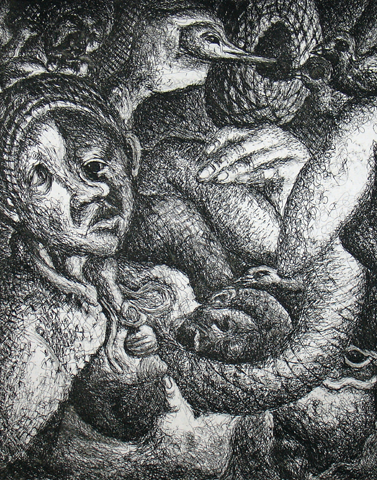
It is far in between
Etching on paper
1990
Oliewenhuis Art Museum Permanent Collection
Internationally acclaimed artist, Helen Sebidi, could be seen as one of South Africa’s foremost female artists. Unlike some well-established artists in South Africa, Helen’s art career started differently as her first teacher of art and aesthetics was her grandmother. She won the prestigious Standard Bank Young Artist Award in 1989, an enormous achievement for a black female artist of that time. Today Sebidi has an extraordinary exhibition history as she participated in numerous group and solo exhibitions in Oman, FundaçãoBienal de São Paulo, and Venice Biennale in Italy, South Africa and London. Her work is also represented in outstanding collections such as Oliewenhuis Art Museum, Johannesburg Art Gallery, Centre for African Studies, University of Cape Town, the National Museum of Women in the Arts, Washington and New York and the Aboriginal Art Museum in Australia.
Sebidi grew up with her grandmother in the village of Marapyane near Hammanskraal in Gauteng. Together they used ash and natural clays to decorate walls and floors of their homes that were built with cow dung and mud. Her grandmother and the village she was raised in remained a great source of inspiration for Helen throughout her artistic career.
In 1959 Sebidi left Marapyane (she was only 16 years old) to find a job in Johannesburg. Like many other young black women during the time of apartheid, Sebidi’s only choice was to become a domestic worker. Fortunately,Sebidi ended up working for a German family that treated her with dignity. It was also at this time she was exposed to oil paint as the woman she worked for, Heidi Petch, was a painter. Sebidi’s first painting attempts were traditional scenes depicted on cardboard. Heidi encouraged Sebidi to explore her natural painting talents.
In the 1970’s Sebidi had to return to Marapyane to care for her ill grandmother, but she continued to paint. Under the guidance of John KoenakeefeMohl, her painting techniques developed. She travelled to Johannesburg from time to time to visit Mohl and started to sell her work. In 1977 she had her first solo exhibition in Joubert Park, Hillbrow, and eventually, her art became her sole source of income. In 1986 she started to work at the Johannesburg Art Foundation and received more guidance from renowned artists such as Bill Ainslie, Linda Ballen, and Ilona Anderson. It was David Koloane who encouraged her to explore abstract expressionism and her style started to shift from romantic representations of rural life to surrealist expressions of humans and animals.
It is far in between (1990) is emblematic of the noticeable shift in Sebidi’s work during the 1990s. Art writer André Croucamp described Sebidi’s style in the 1990’s best by stating that “the images are both fragmented and hybridised. Men and women seem to merge into hermaphrodites. Some figures fan out from the hips into multiple profiles. The eyes in a face are usually of different colours. The faces are fractured, showing both profiles and frontal views in a distortion of perspective. Some art historians have associated this feature of her work with Picasso” (Croucamp 2009: 9).
Oliewenhuis Art Museum is proud to have such an emblematic work of Sebidi, a true representation of this artist’s journey and oeuvre. It is far in between (1990) was purchased from Caversham Press in 1992 and is part of Oliewenhuis Art Museum’s Permanent Collection. Oliewenhuis Art Museum is a satellite of the National Museum in Bloemfontein, an agency of the Department of Arts and Culture, South Africa.
Kimathi Mafafo: #5WomenArtists Campaign

Voiceless VIII
Embroidered panel
2019
Art Bank South Africa collection
The delicate embroidered work of KimathiMafafo, Voiceless VIII, is deceivingly ‘pretty’. At first glance the viewer is mesmerised by the meticulously faint stitches, depicting a female figure situated in a dream-like environment, a forest. The work is delicate and incredibly powerful.
The angelic figure in the artwork is woven into her surroundings by a veil or halo that seems to protect or enfold her. The woman, wrapped in a traditional blanket is sitting, kneeling, or perhaps praying. The detail on the traditional blanket, the repetitive design of corn or the ‘mealie’ has a dual meaning. It refers to both fertility and wealth. This contrast in detail is separating the foreground from the background. Unexpectedly the female figure is the focal point but still woven into a contradictory wallpaper-like background. The artist confirms that “these embroideries tell dark stories of women who are trapped under the weight of tradition, living in a dark space and not realising that the world is beautiful. My work shows that she only has to leave, then she will realise that there is more in life”.
The intensity of this work is situated in the contradicted, layered symbolism of a female figure, elevated in the way she is depicted, but could also be seen as a suppressed symbol, a cultural stamp in a form of a blanket that could be either comforting or suffocating. In conclusion, the artist stated that she is inspired by stories of women around her and likens the women in her narratives to flowers slowly blossoming against all odds, subtly criticising traditional gender roles, while at the same time encouraging women to realise their own strength.
Thandiwe Msebenzi: #5WomenArtists Campaign

Asimboniamakwhwenkweni IV
Pigment print on True Fibre
2019
Art Bank South Africa collection
The brave ThandiweMsebenzi is an artist and activist and is fearless when voicing her opinions about sexual harassment, rape culture, and gender violence. She utilises photography as medium and courageously talks about her personal experiences of gender violation.
The title of her artwork, Asimboniamakwhwenkweni IV, is inspired by a Xhosa childhood song that was sang mockingly by young children to other children who were caught playing games that are not ‘typical’ for their specific gender. In many cultures, there are clear distinctions between ‘girl’ and ‘boy’ appropriate games. When this song is sung, it is a clear indication that you did ‘wrong’ and that you are breaking the boundaries of the expected societal ‘norm’. Boys, who play ‘girl’ like games, would be considered ‘soft’ and be teased.
Asimboniamakwhwenkweni IV is an artwork that strikingly addresses concepts about spaces/places, and the act of play (as the figure in the photograph plays the traditional skipping game) but a loss of spectatorship or participants in this game. The only spectator of the skipping game is the viewer of the artwork.
The figure appears genderless yet surreal and provokes the uncomfortable feeling of being stared at. An interesting aspect of the work is that the figure is playing a traditional African skipping game. But the rules of this game are intentionally adapted within the context/concept of the photograph. Firstly, it is played indoors (which is not common practice within the cultural context of the game, as it is believed to be bad luck to play such a game indoors) and secondly, has only one participant. Three empty chairs take on the role of the other participants. The artist confirmed that “this particular photograph portrays a young, heterosexual boy who is labelled as ‘soft’ and naturally enjoyed games girls played”. Could this be why there are no other participants in his private game? No one to see or mock him? The artist stated that “in navigating his ‘softness’ as a heterosexual boy, he daily receives negative criticism from his community and friends. Songs like AsimboniAmakhwenkweniare part of his daily life”.
Msebenzi questions notions of the gender binary or the classification of gender into two distinct, opposite, and disconnected forms of masculine and feminine, whether by a social system or cultural belief. Asimboniamakwhwenkweni IV is a layered artwork, packed with meaning and symbolism. The foremost striking element of this work is located in the element of isolation where this young man finds himself in. He is facing loneliness as a result of his ‘difference’ that society has imprinted on him.
Nomusa Mtshali:#5WomenArtists Campaign

Inkosi
Mixed media on paper
2019
Art Bank South Africa collection
Nomusa Mtshali questions and unravels thorny, essential debates surrounding gender fluidity, politics, preconceptions and perceptions that are projected on a black female once declared as homosexual, queer, bisexual which leads to being labelled ‘different’ or being othered. Her genre is intrinsically personal, as she states “My quest for belonging and success has brought me against the full force of conservative ideology in South African society. As a queer person of colour, I have found it difficult to feel represented by any single demographic. With my art, I try to quietly and persuasively challenge narrowly-defined concepts like gender and race – with the understanding that no-one fits these boxes perfectly”.
Mtshali’s work, Inkosi, is a striking portrait of a female figure with a strong resemblance to the iconic artist Zanele Muholi, a visual activist and photographer. Muholi’s genre focuses mainly on race, gender and sexuality looking at black lesbian, gay, transgender, and intersex individuals. The title, Inkosi, is both appropriate and ambiguous. Appropriate as it means ‘superior’ or ‘leader’ (Zanele Muholi is, without doubt, a pioneering leader of female activists that openly talks about gender equality and LGQTB politics) but at the same time is the Zulu term Inkosi more likely to be linked to a male leader or king. Mtshali stated that “Inkosi” is an isiZulu word for the “King”. The king is the person who is responsible for the common good of a group of people/society. The king is also a protector as well as a provider. This work celebrates taking a stand and acquiring responsibility for yourself, your family as well as your society. This artwork is inspired by the nurturing that exists in my family”. She further confirmed that “Inkosi” in isiZulu also means “inhloko”, “the head” the one who oversees the operations and governing of society, the family or a large number of people. This piece also touches a lot on gender and celebration of humanity and celebrating the woman/ womxn[1] who are Izinkosi in their own right.
Mtshali portrayed her Inkosiwith her eyes closed, in a trancelike state. Her attire is seemingly traditional; dressed in mostly black and her head carries a crown of feathers. Native American dream catchers round off the attire mostly on her shoulders like a military shoulder belt echoing the trancelike states of the woman as dream catchers are known to neutralise the bad energy around one while being asleep. Mtshali confirmed that she uses it metaphorically to “put emphasis on a protector of dreams and ideas”.
Bibliography
Anon., “Dictionary.com” (available at https://www.dictionary.com/browse/womxn as accessed on 27 February 2020)
Anon., “Ebony curated” (available at https://ebonycurated.com/ebony-artist/kimathi-mafafo-1984/, as accessed on 10 February 2020).
Croucamp, A. 2009. MmakgaboMmapulaMmankgato Helen Sebidi: Educational Supplement Taxi Art Books Series, Taxi 041. Johannesburg: David KrutPublishing.
Schultz, B & Van der Merwe, M. 2003. NoriaMabasa. Johannesburg: David Krut publishing.
[1]The term womxn is used, especially in intersectional feminism, as an alternative spelling to avoid the suggestion of sexism perceived in the sequences m-a-n and m-e-n, and to be inclusive of transgender and nonbinary women.The demonstrators demanded equal treatment for womxn and men alike.



Comments are closed.