


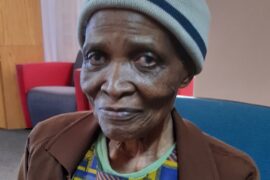
Sixty-one years ago in 1958, a local golfer, David Motati (on the far right in the attached picture), won a stroke play event at the non-white golf course in Bloemfontein. Motati, also known by his nickname ‘Bobby Locke’ (after a famous white South African golfer), famously went on to caddy for Gary Player in the subsequent whites-only SA Open according to the South African Golf Association’s website . Today, this event and player is totally forgotten and even less is known about the history of golf within South Africa’s black communities.
While golf in the white community for both men and women has been well documented, blacks are still largely excluded from the narrative. Robert Fall’s Golfing in Southern Africa and its list of ‘Who is Who in Southern African golf’ mentions no black golf club, association, event or person. Similarly, the Illustrated African Golfer, a golfing magazine published for a short period before the Second World War, omitted any reference to any black South African in the game. To this day, the only publication with a focus on early black golfers remains the pocket-sized booklet published in 1947 by Simon Malaza, secretary of the Transvaal Bantu Golf Union. Four recent publications suffer from the same deficiencies.


The first national open golf championship for white golfers took place in Kimberley from 26 September to 1 October 1892 and laid the foundation for a range of others including the S.A. Amateur Championship that followed a year later and the Johannesburg Christmas Tournament that was hosted in 1895. By 1895, because of the increased popularity of the game, club representatives of the Cape Colony and Orange Free State felt it necessary to further codify their game by defining both the terms ‘amateur’ and ‘recognised golf club’. In the case of the latter, a recognised golf club was defined as “one which keeps up its own links, has elected officers, and whose members pay a subscription.” Any club or association that lacked own facilities was therefore automatically disqualified from obtaining membership of what later became the SA Golf Union in 1910. With this measure, golf administrators formally aligned themselves with their peers in a range of other sport organisations that used sport to “reinforce white power and difference.”

According to contemporary media reports Ramnath ‘Bambata’ Boodhan, a Durban-based caddie and repairer of clubs under the apprenticeship of white Durban Golf Club professional George Fotheringham, and thanks to the assistance of some beneficiaries, entered the British Open in 1929 and became the first black South African golfer to compete internationally. His participation in three further tournaments and intention to qualify as an assistant professional created a new awareness of the existence of black golf prowess in South Africa.
Despite Boodhan’s lack of success on the European circuit, his endeavours inspired others and evidently played a role in the formation of a number of golf clubs in Natal, Transvaal, Cape Province and Orange Free State. Amongst the pioneering clubs were the Durban Indian Golf Club (est.1929), Payneville (1930), and the Wynberg (1931) golf clubs in Johannesburg and Sunningdale Park in Cape Town shortly thereafter.

The Bochabela Section, in turn, was under the leadership of T. Thate (President), Jackie Barry (Vice-president), Lazarus Zeeco (Chairman), Matthews Thlong (Vice-Chairman), Z.S. Motlohi (Secretary), J. Mogajane (Assistant Secretary), Jacob Mooki (Treasurer), with Sam Molatedi and Joe S. Thlong as captain and vice-captain, respectively. In comparison to the Bloemfontein club with its larger membership, the Bochabela club with half the number of players, went out of the way to assign responsibility to each of its membership. This almost extreme display of ‘club democracy’ was probably aimed at maintaining a high level of interest amongst its members and to ensure that each individual play his role. Some reports further indicate that the two clubs lacked proper playing facilities and practiced their sport on a makeshift course in the open field. The activities of these clubs, however, remain the subject of further research.
References:
Cohen, B. 2019. Blazing the Trail: Celebrating 90 Years of Black Golf in Southern Africa. Johannesburg.
Fall, R.G. 1958. Golfing in Southern Africa. Salt River: SA Golf Pty. Ltd.
Malaza, S. 1947. The Bantu Golf. Johannesburg: Lovedale Press.
Mancoe, J. 1934. Bloemfontein Bantu and Coloured People’s Directory. Bloemfontein: AC. White.
Nicholson, C. 2005. Papwa Sewgolum: From Pariah to Legend. Johannesburg: Wits University Press.
South African Golf Association, http://history.saga.co.za/index4133.html?id=151. Accessed 25 October 2018.
The Illustrated African Golfer, vol. 1, no. 3 (June, 1934).
Western Cape Archives and Record Services: Cape Archives Division (CAD), Accessions (A), 727: Golf. Copy of Minutes, 8 October 1910.
Western Cape Archives and Records Services: Colonial Office (CO): 4017: 287 Memorials Received – CL Herman; WF Hertzog and P Van Breda, 23 January1843.


Comments are closed.