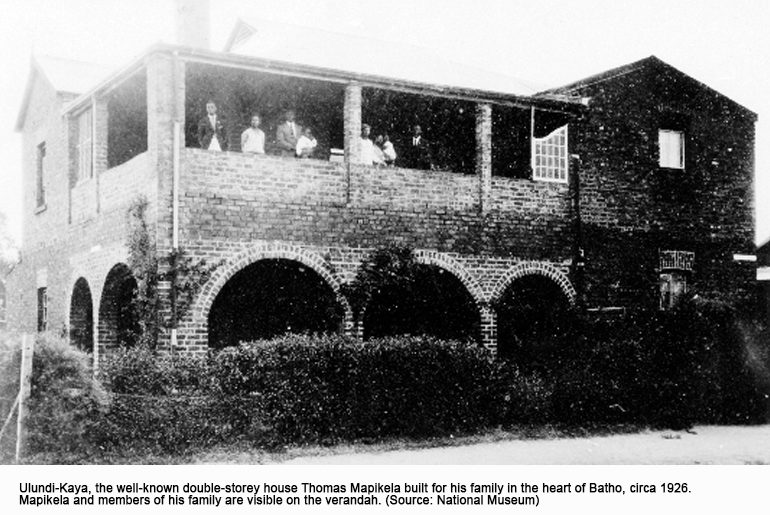
In 2018 Batho, Bloemfontein’s oldest existing historically-black township or so-called ‘location’, celebrates its centenary. Compared to other South African townships of similar size and age, Batho is no ordinary township because of its rich and colourful history. During the past 100 years much had happened there, most notably on a socio-political level. For example, consider the fact that the well-known founder-member and first speaker of the South African Native National Congress (later ANC), Thomas Mapikela, lived in Batho until his death in 1945.
Rachel Thoka was born around 1825, apparently in a West African country. As a young girl she was sold in the slave market in Cape Town to a white farmer, Sarel Griesel, whose wife wanted a young slave. In typical Afrikaner tradition of the time, the Griesels gave her a new name taken from the Bible, namely Rachel, and she learned to speak Dutch.
Although slavery was abolished in the Cape Colony on 1 December 1834, Rachel remained in the service of the Griesels and during the Great Trek (c. 1834–1838) travelled with them into the Transgariep (today Free State) and Natal.
https://www.sahistory.org.za/topic/walter-sisulu-timeline-1912-2003
Audrey Hepburn once said that the best thing to hold onto in life is each other. In this month of love, we look at the inspiring love story of two struggle heroes, Walter and Albertina Sisulu. Their love survived the dark days of apartheid, when Walter Sisulu was imprisoned eight times, banned, placed under house arrest, tried twice for treason, and, in 1964, jailed for life.
“Blazen en snorken” en “Woest rijden”: Verkeersweë en vervoer in Bloemfontein teen die laat-negentiende eeu
Marianna Botes1 en André Wessels2
1Departement Geskiedenis, Nasionale Museum, Posbus 266, Bloemfontein, 9300, Suid-Afrika
en Navorsingsgenoot, Departement Geskiedenis, Universiteit van die Vrystaat, Bloemfontein
2Departement Geskiedenis, Universiteit van die Vrystaat, Posbus 339, Bloemfontein, 9300, Suid-Afrika en Besoekende Professor, Australian Defence Force Academy, Canberra
Toentertyd met die koms van die motorkar na Suid-Afrika het verkeersreëls en -regulasies vanselfsprekend met die toename in verkeer al hoe meer op die voorgrond getree om orde op dié terrein te handhaaf. Bygesê, selfs met die trapsuutjiespoed van die destydse motors en spoedbeperkings van so laag as 15 m/h (24 km/h) het ongelukke sporadies plaasgevind weens onvoldoende verkeersreëls en die gebrek aan die nougesette toepassing daarvan.
